Rooted Meadows School Concept
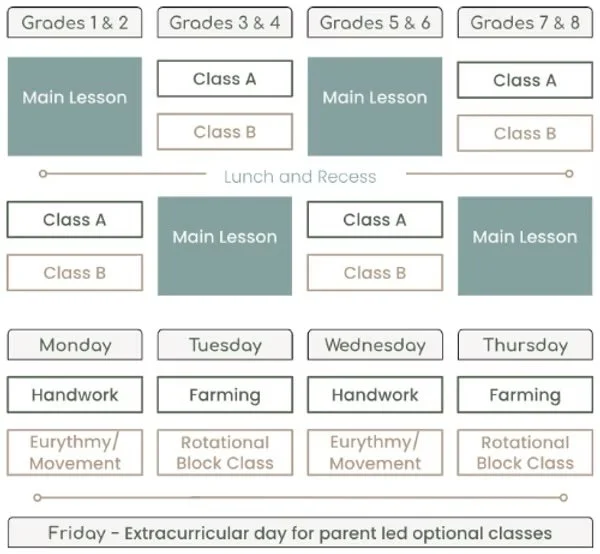
Micro School, Micro Schedule
5 Hours Per Day, 4 Days Per Week
Why a Micro School?
A Waldorf-inspired micro-school offers a deeply intentional learning environment, where children are truly known. With smaller group sizes and mixed-age learning, children build strong relationships not only with their teachers, but also with one another, developing empathy, leadership, and collaboration across ages. Children learn to communicate with a wide range of peers, resolve conflicts thoughtfully, and take meaningful roles within a close-knit community.
Our experience visiting micro schools has shown us how powerfully this model supports academic learning, creativity, and life skills that are often missed in larger settings. Beginning as a micro-school allows us to grow organically, establish a strong school culture, and create a warm, connected foundation that will carry forward as the school grows.
Why The Pedagogy We Choose?
While many envision Waldorf schools or Waldorf-inspired schools full of beautiful wooden toys, pastel silk scarves and organic snacks, its true heart is far deeper: it was created by Rudolph Steiner with the radical intention to raise better humans for a better world.
In a society currently fractured by youth anxiety and depression, childhood diseases, screen addiction, overwhelming parental isolation and depletion, and divided societies, we choose this pedagogy to help us offer a vital lifeline and a healthier, more connected way to live. By stepping away from a culture of hyper-competition, materialism and digital exhaustion, we protect childhood and teach our children to look for beauty, practice goodness, and take active responsibility for the world around them. Ultimately, we chose to be Waldorf-inspired to raise grounded, confident, resilient, and compassionate human beings our communities so desperately need.
Why a Farm-to-Table Program?
Our Farm-to-Table program is the beating heart of our co-curricular journey, seamlessly weaving together Farm & Garden, Fiber Arts, and Cooking.
Whether it’s a Fiber Arts student weaving with wool they helped shear, transforming marigolds into natural dyes for a sewing project, or a child preparing a wholesome omelet for their classmates to share, these real-world connections anchor learning in something tangible and authentic.
In an increasingly digital and fast-paced world, this program provides a necessary "grounding" that yields benefits far beyond the classroom.
Why A Hybrid School?
A hybrid model offers the best of both worlds by blending the structured, professional curriculum of a private school with the flexible, family-centered rhythm of homeschooling. By utilizing a cooperative framework where parents help teach and support classes, we are able to significantly lower operational costs and make high-quality Waldorf-inspired education genuinely affordable for families. This unique partnership creates an ideal balance—fostering deep community, expert instruction, and vital social peer interactions without sacrificing precious family time or financial accessibility.
Teachers Certified at Waldorf Institutes
We plan to hire 2 teachers (grow to 4) trained and certified at an Accredited Waldorf Institution to provide instruction to combined grades for the main lesson portions of the school day, covering the core subjects.
Speciality Teachers
Teach co-curricular subject class: Handwork, Cooking, Biodynamics Farming, and eventually Eurythmy & Movement.
Parents and Volunteers
Lead the rotational block classes that happen twice a week and the Friday student interest-based extracurricular class and clubs offered though our BRANCH Program.